
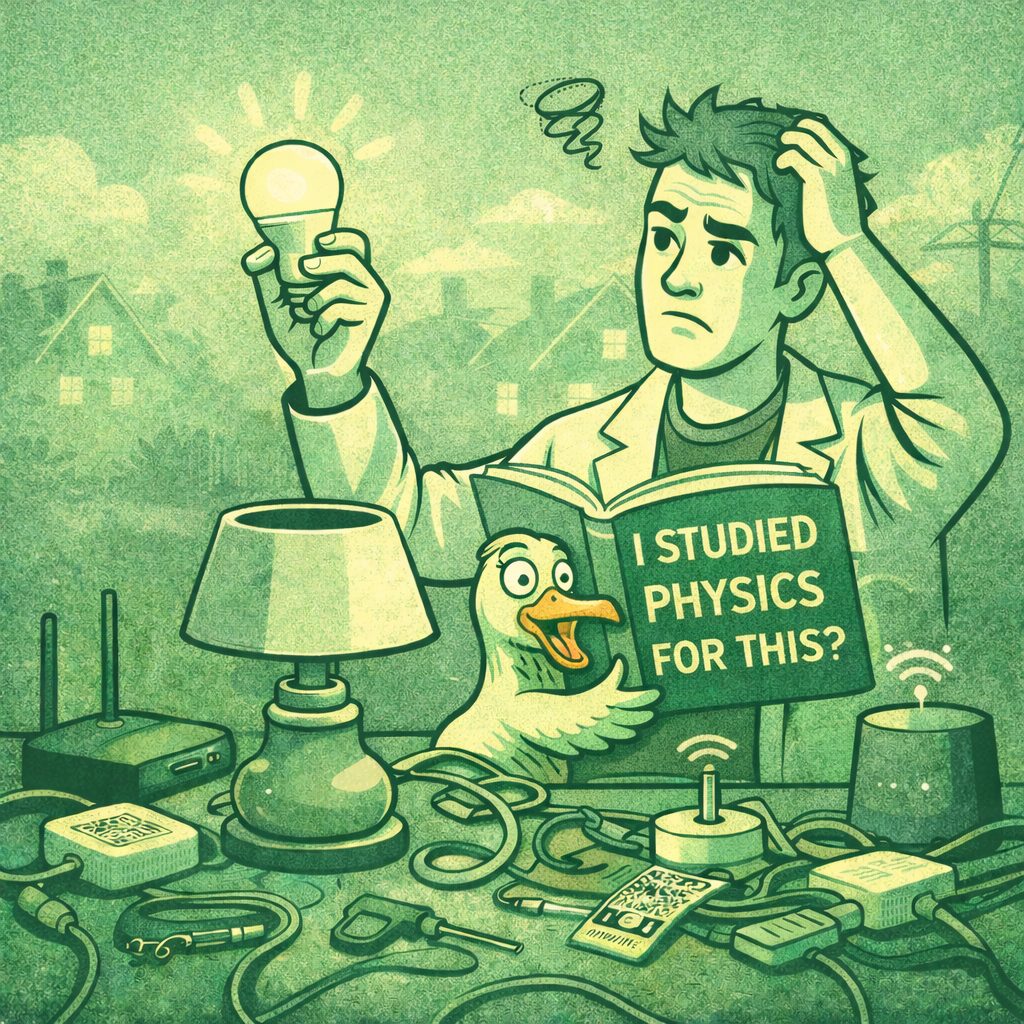
I’m perpetually torn between embracing new technology and keeping it simple. Being a technologist, the former usually wins. Nowhere has that inner conflict been more punishing than my recent attempt to install “smart” lightbulbs. Ted Kaczynski would like to have a word.
The pitch is great: control the lights on/off, dim them, shift color temperature, and do it all with Siri. Being who I am, I like standards, so I bought bulbs that speak Matter over Thread, a newfangled protocol stack that runs in parallel to WiFi. Thread is the wireless mesh. Matter is the language the devices speak to a controller, which Apple has decidedly branded “HomeKit.” Seriously, who names these things? We’re installing lightbulbs, remember.
It’s supposed to be dead simple. Open the Apple Home app, scan the QR code, watch the bulb connect. But that would be too simple. The dialog sat on “Connecting…” for two minutes before cheerfully announcing “Unable to Add Accessory.” So I tried again. And again. Same result. I flipped the lamp switch. I enabled IPv6 on my router. I power cycled the Apple TV, which doubles as my Thread Border Router. Eureka. It finally paired. (Shopping tally: 3 bulbs.)
I added the two remaining Nanoleaf bulbs, set up a warm evening scene, and basked in my smart-home triumph. Then I turned on the TV to test Apple TV as a controller. Flicker. Flicker. Twenty seconds later, exactly one of the three bulbs changed color. It’s supposed to be instant and control all of them. Something was broken.
I consulted the web and the oracles themselves, Dr. Claude and Dr. ChatGPT. I was not alone. Thread’s reputation for instability precedes it. Power cycling the Apple TV would temporarily fix things, but the system always decayed. An hour later, a day later, accessories started dropping off like flies. My physics degree was not preparing me for this. Years of mechanics, E&M, and thermodynamics classes and I was now googling whether my neighbor’s microwave could take down my lightbulbs.
So I went on a shopping spree. Maybe the Nanoleafs were junk, so I bought a set of Aqara T2 bulbs. (Tally: 6 bulbs.) Maybe my Amplifi WiFi was the issue, so I bought a Unifi Express. (Tally: 6 bulbs, 2 WiFis.) Still flaky, so I bought an Eero. (Tally: 6 bulbs, 3 WiFis.) I toggled every arcane networking setting I could find on the Unifi. I bought an Aqara smart hub to try the bulbs over Zigbee, an older mesh standard. Zigbee. I cannot stress enough how stupid that name is.
Zigbee was more stable, but didn’t play nicely with HomeKit’s adaptive lighting, which gradually shifts the bulbs from cool morning white to warm evening amber. I was a week deep at this point. Apple and every other big tech player has endorsed Thread. There had to be a way to make it work.
My next theory was RF interference. Maybe a neighbor’s WiFi was stepping on my mesh. I changed channels (Channel 11 is a known Thread offender). I cycled my heating fan in case the motor was leaking signal. Nothing.
Then, on a whim, I killed the soundbar and wireless subwoofer. Every bulb reconnected. Every scene worked. Hallelujah.
The culprit: the 2.4GHz link between my soundbar and subwoofer was shouting loud enough to drown the entire Thread mesh. And the reason I’d never caught it? My so-called “Apple TV power cycles” were really flips of the power strip that feeds the TV, soundbar, and subwoofer. The subwoofer stayed off until the TV came back on, long enough to make me think the reboot had fixed things. The Apple TV remote doesn’t fully kill the sound system, but the TV’s original remote does. So the solution, after two weeks of muttered profanity, was to just turn the sound system off when I’m done watching TV. Dr. Claude and Dr. ChatGPT never did diagnose that one.
Subwoofer exiled, the Thread network has been rock solid. I’ve since added a Thread soil sensor for the indoor garden, a HomePod mini I grabbed off Facebook Marketplace (which extends the mesh and acts as a second border router), and a Raspberry Pi running HomeAssistant to pull my thermostat and door lock into HomeKit. Nothing says “the future” quite like needing three committee-named standards and silencing a rogue subwoofer to turn on a lamp. Ted would be proud.
The Nanoleafs went back (Aqaras are better). So did the Aqara hub (HomePod and Apple TV handle it) and the Eero. The Unifi Express 7 stayed. It warmed my inner networking engineer’s heart.
So, final answer: it takes precisely 11 days, 3 WiFis, 3 smart hubs, 2 sets of smart bulbs, and a physics degree to screw in a light bulb.